


Yes, an RO filter can handle borewell water in Nepal, but it is not recommended. If you’re using borewell water in places like the Kathmandu Valley, the Terai, or even smaller towns, you’ve probably noticed it can have a lot of iron, ammonia, hardness, and other minerals that aren’t good for your health or your plumbing.
RO systems are made for this kind of water. They remove heavy metals, reduce Total Dissolved Solids (TDS), and get rid of bacteria and viruses. Regular carbon or UF filters don’t do the same job. The RO membranes have super tiny pores, around 0.0001 microns, which can trap arsenic, iron, manganese, and harmful microbes. That’s what makes the water safe and healthy to drink.
In Nepal, where groundwater often goes beyond safe limits, having a borewell water RO filter isn’t just a good idea, it’s really necessary if you want clean, safe, and tasty drinking water.
Why Borewell Water in Nepal Needs an RO System?
In Nepal, if you’re using borewell water, you’re basically getting a mix of all sorts of minerals and other stuff you don’t really want in your water. Groundwater is super important for places like the Kathmandu Valley and the Terai, but a lot of the time it’s not exactly “safe” by the National Drinking Water Quality Standards (NDWQS).
That’s where a good RO system from Ultra Group Nepal comes in, it really makes a difference at home.
High TDS and Hard Water Issues
So, groundwater naturally picks up minerals like calcium and magnesium as it passes through the soil. That’s what gives it high Total Dissolved Solids (TDS).
- The Problem: High TDS means hard water. Your water tastes a bit off, and you get that annoying white scale building up in your pipes, taps, and appliances like geysers.
- The Fix: Ultra Group’s RO membranes have super tiny pores, around 0.0001 microns, which take out these dissolved salts. Your water tastes better, and your plumbing and appliances stay happier for longer.
Heavy Metal Contamination (Iron, Arsenic, Manganese)
Some places in Nepal have heavy metals that ordinary filters just can’t handle.
- Iron & Manganese: This is common in Kathmandu. It can turn your water reddish-brown, leave a metallic taste, and stain clothes and bathroom tiles.
- Arsenic: Big concern in the Terai. Long-term exposure can cause serious health issues like skin problems and organ damage.
- The Fix: RO systems are great at removing these heavy metals. Basically, they make sure your drinking water is safe and clean.
Microbial and Pathogen Protection
In crowded areas, shallow borewells sometimes get contaminated with bacteria from septic seepage.
- The Problem: Things like E. coli can sneak in, causing diarrhea, typhoid, or even cholera, especially during the monsoon.
- The Fix: Ultra Group’s systems, like the UltraTec RO730F, use a two-step approach. First, the RO membrane physically blocks microbes. Then, a built-in UV sterilizer kills 99.9% of bacteria and viruses, just to be safe.
Why Ultra Group Stands Out: Unlike generic imported filters, Ultra Group Nepal has been making solutions for local water since 1997. Their heavy-duty PP Sediment filters are made for Nepali borewells, handling all that iron and sand so your RO membrane lasts longer and you save money on maintenance.
Standard Filter vs RO Filter for Borewell Water
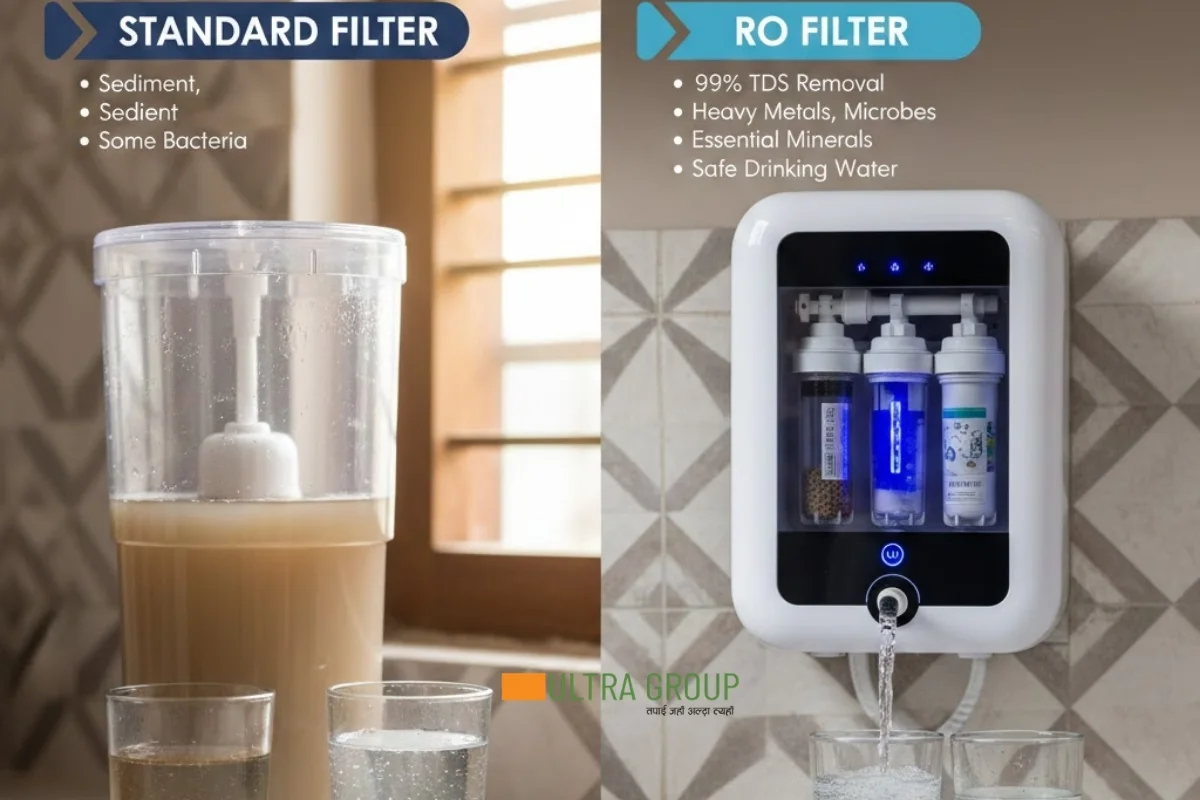
Not all filters work the same when it comes to borewell water in Nepal. Standard filters, like UF (Ultra Filtration) or those simple gravity-based ones, can get rid of dirt, sand, and maybe some bacteria, but that’s about it.
They can’t touch dissolved salts, heavy metals like iron, arsenic, manganese, or harmful microbes. So even after filtering, the water might still taste metallic, feel hard, and honestly, it could cause health issues if you keep drinking it.
An RO filter for borewell water, though, is a whole different game. These are built to handle the tough stuff. The membranes are super fine, around 0.0001 microns, so they can remove up to 99% of total dissolved solids (TDS), heavy metals, bacteria, and viruses.
Plus, a lot of RO systems, especially Ultra Group Nepal RO, add Alkaline and UV stages. That means your water gets essential minerals back, the pH balances out, and there’s extra protection from germs.
Key Differences:
- Standard Filter: Removes sediment and some bacteria; water can still be hard and not fully safe over time.
- RO Filter: Removes dissolved salts, heavy metals, and microbes; gives you safe, clean, and great-tasting water.
For families or offices using borewell water in Kathmandu, Terai, or other places with high TDS, an RO filter for borewell water is really the way to go. It keeps you healthy and also stops scaling in pipes and appliances, saving money on maintenance in the long run.
Recommended Read: RO vs Filter
How RO Technology Solves Borewell Water Challenges?
RO technology is the most effective solution for treating borewell water in Nepal. Reverse Osmosis (RO) filters remove up to 99% of dissolved salts, heavy metals, bacteria, and viruses, while also improving taste and odor, making it ideal for water with high TDS, iron, and ammonia levels.
1. RO Membrane & Filtration Capabilities
- The RO membrane has ultra-fine pores (~0.0001 microns), which can filter out:
- Dissolved salts and hard water minerals (calcium, magnesium)
- Heavy metals like iron, arsenic, and manganese
- Harmful bacteria and viruses
- Ammonia, sulfur compounds, and metallic taste
2. Multi-Stage Purification Explained
Stage | Filter Type | Purpose |
1 | PP Sediment | Removes sand, silt, and high iron content |
2 | GAC | Removes chlorine, odor, and chemicals |
3 | CTO Carbon | Improves taste, removes organic compounds |
4 | RO Membrane | Eliminates heavy metals and reduces TDS |
5 | Alkaline | Balances pH and adds essential minerals |
6 | UV | Kills bacteria and viruses, ensuring safe water |
3. Taste & Odor Improvement
- Removes unpleasant ammonia, sulfur, and metallic taste.
- Alkaline stage restores essential minerals and ensures water is not flat or acidic after purification.
Introducing Ultra Group Nepal: Tailored RO Solutions

Ultra Group Nepal offers RO solutions made specifically for the tricky borewell water in Nepal. They’ve been around since 1997, so that’s over 25 years of experience dealing with local water problems. Over time, they’ve built a reputation for making reliable, high-performance water purification systems that actually last.
Why Choose Ultra Group RO Filters?
- Multi-Stage Protection: Their RO systems go through a 6-stage purification process, so the water is safe both chemically and biologically.
- Advanced UV + Alkaline Technology: The UV sterilizer kills 99.9% of microbes, and the Alkaline filter balances pH, making the water healthier and better tasting.
- Durability: Built tough. The heavy-duty parts handle high iron levels and the pressure swings that are common in Nepali borewells.
- Versatile Solutions: They’ve got everything from small home units to big commercial RO plants (250–1000 LPH), so there’s a system for just about any need.
Popular Models
Model | Best For | Key Features |
RO730F | Families | Alkaline filter, UV sterilization, Hot/Cold water |
RO730C | Offices | Hot & Cold water dispensing, UV sterilization |
RO650 | Compact/Domestic | Basic RO + UV |
RO730G | Domestic Use | Popular Model |
RO750A | Commercial | Safe and reliable |
Pro Tip: If your borewell water has high iron, always go for heavy-duty sediment pre-filters. They stop the RO membrane from clogging and save you money on maintenance.
Price Comparison of Ultra RO Water Purifiers in Nepal
Ultra Group Nepal has a bunch of RO systems made specifically for Nepali borewell water, so they can handle high TDS, iron, and microbial contamination. Here’s a handy price comparison of some popular models, showing both the original and current prices:
Product Name | Model | Original Price (₨) | Current Price (₨) |
ULTRA Mineral RO Water Purifier | Ultra RO730G | 25,000 | 18,750 |
ULTRA Mineral RO Water Purifier | RO500B | 28,500 | 21,375 |
ULTRATech Mineral RO Water Purifier | UltraTec RO730D | 35,000 | 28,000 |
Ultra Mineral RO Water Purifier | Ultra RO730D | 35,000 | 31,500 |
ULTRATEC Mineral RO Water Purifier | UltraTec RO730F | 35,000 | 31,500 |
ULTRA Mineral RO Water Purifier | Ultra Tec RO730C | 40,000 | 30,000 |
ULTRA Mineral RO Water Purifier | L-RO801 | 40,000 | 36,000 |
ULTRA Pure Mineral RO Water Purifier | UltraPure L-RO730E | 48,500 | 38,800 |
ULTRA Mineral RO Water Purifier | Ultra L-RO650A | 60,000 | 45,000 |
ULTRA Mineral RO Water Purifier | Ultra L-RO750A | 93,000 | 69,750 |
ULTRA Mineral RO Water Purifier | Ultra L-RO750B | 99,000 | 74,250 |
Quick Insights
- Domestic Models: Ultra RO730G, RO500B, and RO730D are great for families. They cover the basics—RO + UV + Alkaline protection—so your water is safe and tastes good.
- Office/Commercial Models: Ultra Tec RO730C, Ultra L-RO650A, and the Ultra L-RO750 series are better for offices or bigger households that need more water every day.
- Best Value: The current prices include seasonal discounts, so it’s easier to pick a system that fits both your budget and water needs.
If you’re not sure which RO purifier works best for your borewell water, or if you need installation in Kathmandu or other major cities, you can reach out to Ultra Group Nepal, they’ll guide you through it.
Choosing the Right RO System for Nepali Borewell Water
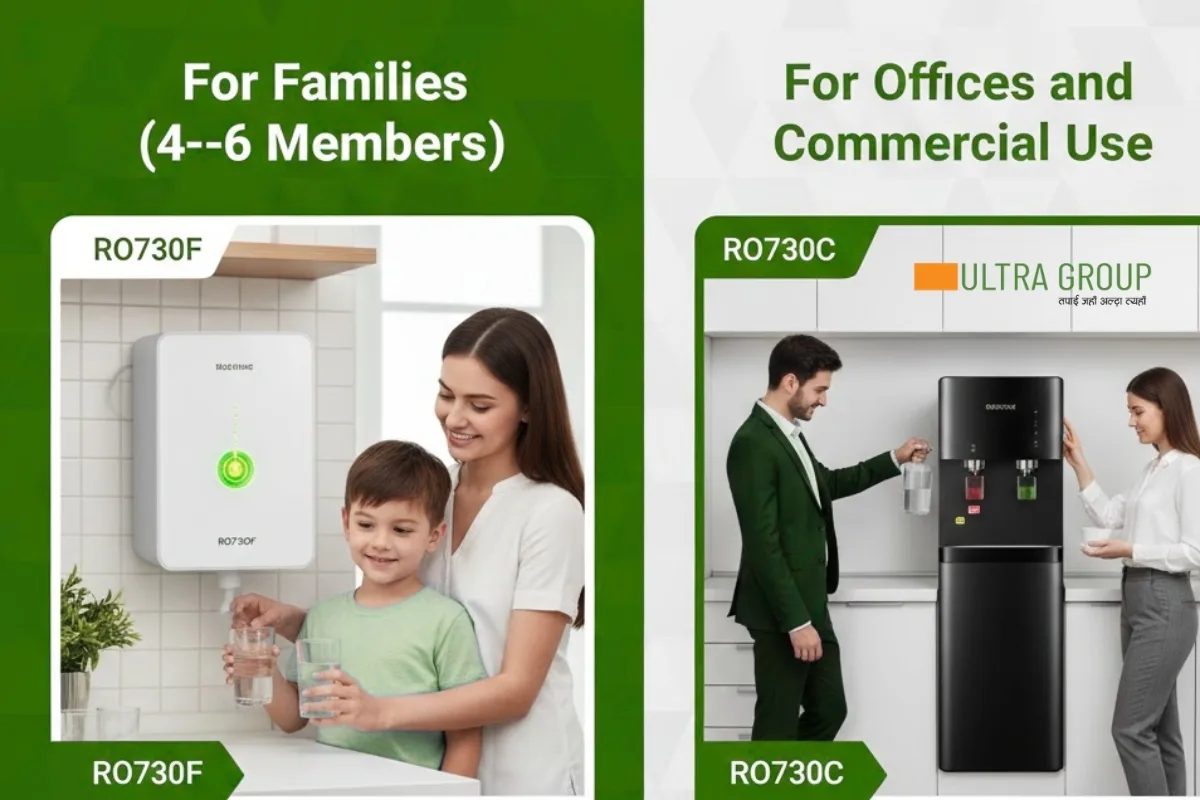
Picking the right RO system really depends on how much water you need, whether it’s for your home or an office. Ultra Group Nepal has models made specifically for Nepali borewell water, so they can handle high TDS, iron, and microbes without breaking a sweat.
For Families (4–6 Members)
- Recommended Model: RO730F
Key Benefits:
- The Alkaline filter brings back essential minerals and balances pH, so the water tastes natural.
- UV sterilization kills 99.9% of bacteria and viruses.
- Works reliably even with high iron and hard water conditions.
For Offices and Commercial Use
- Recommended Model: RO730C
Key Benefits:
- Hot & cold water dispensing, perfect for tea, coffee, or office needs.
- Multi-stage filtration keeps water safe from chemicals and microbes.
- Can handle small offices or commercial spaces, with 250–1000 LPH capacity.
Pro Tips for RO Maintenance in Nepal
- Always use heavy-duty pre-filters to deal with sand, rust, and high iron content.
- Auto-flush features help extend the RO membrane’s lifespan.
- Replace filters on time, according to the manufacturer’s instructions, to keep water quality high.
Final Verdict
An RO filter for borewell water can really handle the challenges of Nepali borewell water. In places like the Kathmandu Valley and Terai, borewell water often has high TDS, iron, ammonia, and microbes, stuff that standard filters just can’t fully remove. An RO system takes care of heavy metals, bacteria, and viruses, making the water safe and tasty. Plus, it protects your pipes and appliances from scaling caused by hard water.
Using a reliable RO system means your family gets clean, healthy drinking water every single day. And if you want professional advice, installation, or to check out the full range of RO systems made for Nepali borewell water, Ultra Group Nepal is the go-to option.
Visit Ultra estore and make your purchase now!
FAQ – Borewell Water & RO Filtration in Nepal
Yes. RO systems come with heavy-duty sediment pre-filters and membranes that can remove iron really well. This stops scaling, stains, and that metallic taste you often get in borewell water.
It depends on your water. If your borewell has high TDS, heavy metals, or microbes, an RO filter is highly recommended. Standard filters or UF systems just can’t make the water fully safe to drink.
For families, go for models with UV sterilization and Alkaline filters. They make the water safe and tasty. For offices or commercial spaces, systems with hot and cold water dispensing work better for tea, coffee, and daily use.
Usually, every 2–3 years. But it really depends on your water quality and how much water you use. Regular replacement keeps your water safe and the system running smoothly.
Yes! RO systems with an Alkaline filter bring back essential minerals, balance pH, and make the water healthier and more pleasant to drink.
Yes. They offer professional installation and delivery across Kathmandu and major cities, so your RO system works properly from day one.
Domestic models usually range between रू 20,000 and रू 32,000. Prices vary depending on the model, capacity, and extra features like hot/cold dispensing or UV sterilization.
Yes. RO systems with UV sterilization remove 99.9% of bacteria and viruses, so the water is safe for drinking and cooking.
Absolutely. RO water is safe for all cooking purposes. And if it’s alkaline RO water, it even makes your tea, coffee, and food taste better while keeping it free from harmful contaminants.


